—Peter Krausz: (No) man’s land
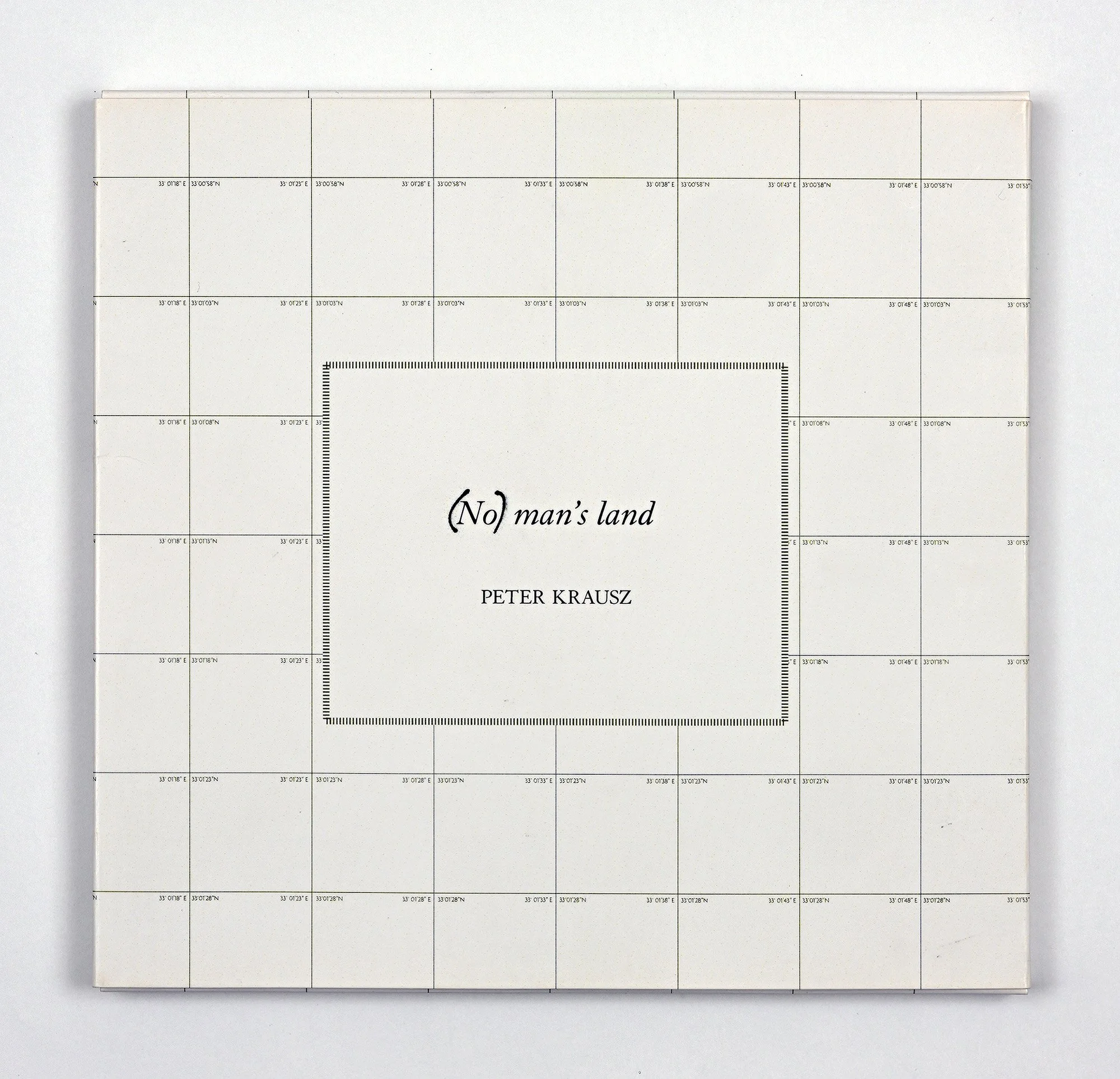
—Peter Krausz: (No) man’s land
Self-published by Peter Krausz, 2010. French and English texts by Horia Avram, Florence Chantoury-Lacombe and Peter Krausz; 19 × 20.3 cm (7.5 × 8 inches) printed card box with flaps containing two 16-page saddle-stitched catalogues and two accordion-folded pamphlets, offset. Design by François Turcotte.
“With the two series The Island of Aphrodite and Nekri Zoni, Peter Krausz offers us an account of the development of a viewpoint: that of the photographer who goes to the island of Cyprus wanting to map out the landscape from the ground, and that of the aerial images of the same site generated by Google Earth. The no man's land, the corridor of fallow land where nature's detail has no hold, is difficult to pinpoint in the figurative landscape. By means of the detail afforded by sheer painting, the artist finds a position that deflects the representation of his intention.
The depiction of a peaceful, fertile land's lush vegetation is subverted by the painted landscape's illustration of the political condition of that place. The twofold nature of the concept of detail as described by Daniel Arasse is given unexpected expression in Peter Krausz's work. Within the figurative landscapes of The Island of Aphrodite can be recognized the clear image, perfectly mimetic unto the last detail, of an object. In Nekri Zoni can be seen a manipulation of the pictorial medium that is as opaque to representation as it is manifestly dazzling in presence. The first nature of detailiconic — represents, and the second — pictorial, shows the handling of paint. However, this new visual approach is generated by a thoroughly paradoxical pictorial calamity. The detail concerning the border zone, as seen in the Nekri Zoni panels whose composition was based on the aerial views of Cyprus, becomes evident through the distancing of the eye from the place observed. To better show the detail, the painter takes a distant view; in contrast, to better appreciate the paintings' detail, the curious spectator moves close up. In this way, looking at the paintings from close quarters does not break up what is visible, and the abstract character of the panels does not remove the landscape from its location.
Through its attention to the political transformation of landscape, Peter Krausz's series of landscapes takes us along a journey in which viewpoint reigns supreme. Unlike the Lorenzetti brothers, who idealized the landscape through painting in order to glorify the Sienese peace, Peter Krausz places two pictorial systems face to face to show the work of an ideology on a legendary land, the island of Aphrodite. Simply looking may not be enough to grasp a fact; the act of showing can point our view in the direction of what should be seen.”
> Florence Chantoury-Lacombe, guest writer